
By Giulia Saladino and Rutger Muller of Bepakt (Revision April 20th, 2018)
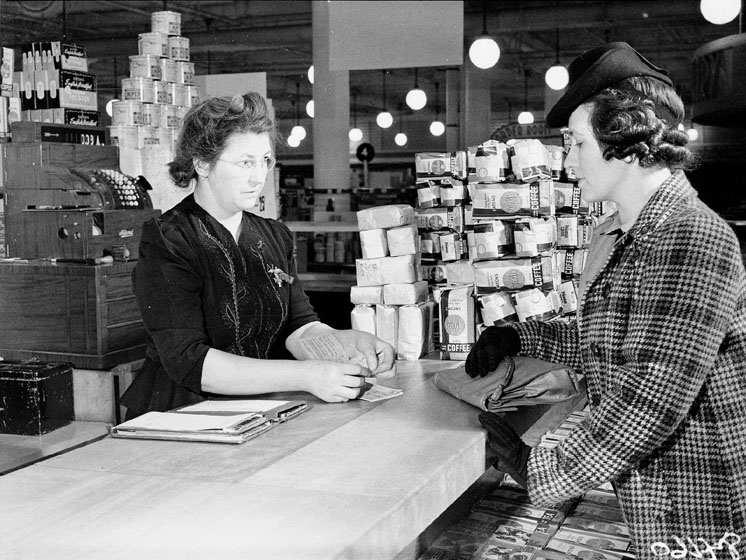
‘Buying food at Eaton’s using ration coupons’ (Toronto, Canada, 30 March 1943), photo by John H. Boyd, public domain via Wikimedia Commons

Groceries played an important role in the development of all civilisations. Already in the world’s earliest of settlements, people were trading food. Today, our national and global culture keeps evolving. This can be observed in grocery shopping developments and innovations:
18??-1915: over-the-counter grocery shops were common. Women used to go to the shop with the grocery list, where the clerk would take the products from the shelves, while giving product advice.
1910, New York City: the appearance of the rolling stoRe (source: Time Magazine): supermarkets on trucks, allowing people in the villages to do grocery shopping, without having to go to farms or distant grocery shops. Rolling store entrepreneurs took advantage of the fact that trucks had fewer overhead costs than fixed locations.
1916, Memphis, Tennessee, USA: Piggly Wiggly (source: Wikipedia) was founded as the first self-service grocery store. From this time forward on, customers were allowed to pick up items by themselves. These shops were not yet supermarkets, but already introduced 3 fundamental designs:
- the entrance turnstile, obliging customers to enter the shop from one side and exit from the other
- the (metal) basket, to carry the products directly picked from the
- the price tag, which allowed customers, for the first time ever, to know the price of the goods before buying them.
1927, Dallas, Texas, USA: the first convenience store was born out of Joe C. Thompson‘s egg. As a manager of a Southland Ice Company ice plant, he started selling milk, bread and eggs (“convenience items”) from an ice dock on Sundays and evenings, when the grocery stores were closed.
These convenience stores were soon bundled together as a franchise named Tote’m Stores (source: Wikipedia: ‘7-Eleven’). (In 1945 the company became 7-Eleven, explained further below.) The outbreak of the Great Depression in 1929 made cash money scarce, therefore convenience storesperfectly met the needs of the people concerned with saving money.
1930, August 4th, Long Island, NY, USA: King Kullen (source: Wikipedia) was the first supermarket (superstore). This new type of grocery store gained a lot of success thanks to the fact that consumers now had cars to reach the supermarket and do an abundant amount of grocery shopping, which could then be stored for long, thanks to refrigerators (source: Engineering and Technology History Wiki) becoming more mainstream.
It must be noted though, that some places still didn’t have home refrigerators for decades to come. In the Netherlands, for example, it took until roughly 1970 for the majority of household to own one (source: Techniek in Nederland).
1931-1933, Portland, Oregon, USA: Fred Meyer developed the first hypermarket: a combination of a supermarket, pharmacy and clothing shop (Walmart followed much later, in 1988, with their first “Supercenter” in Washington, Missouri, USA).
1937, June 4th, Oklahoma, USA: Sylvan Goldman (source: Wikipedia) invented the (double-decker) shopping cart (source: Wikipedia) revolutionising the supermarket’s shopping experience. But it would take over 10 more years (source: Wired) for the shopping cart to evolve into the model we know today; with an in-built chair to carry children, and a flip-door allowing carts to be pushed into one another for space efficient parking.
Also in 1937: A Piggly Wiggly spin-off, called Keedoozle (source: Wikipedia) was created as a prototype for a semi-automated grocery shop. Customers were given a paper tape, in which they could punch holes to order products displayed behind glass windows. At the cashier operated check-out, the punched tape was used to A) mechanically calculate the total price and B) send the order to a manually operated supply room, from which the products were delivered via a conveyor belt. Keedoozle failed because the mechanisms weren’t efficient enough
1945, USA: the Tote’m Stores convenience store franchise rebranded itself as 7-Eleven. (source: Wikipedia). It kept on expanding and introduced for the first time the unprecedented opening times: 7AM (7:00) to 11PM (23:00).
1950s (late) the American supermarket model, a bigger version of the self-service grocery shop, was brought to Europe by for example Delhaize (FR) (source: Wikipedia [FR]) and Tesco (UK) (source: Wikipedia).
1961, Belgium: a law that restricted the size of supermarkets was abolished. Grand Bazar (source: Wikipedia) responded by opening Europe’s first hypermarkets called SuperBazar.
1963, Sainte-Geneviève-des-Bois, France: opening of the first Carrefour hypermarket (source: Wikipedia: Carrefour – History).
1974, Troy, Ohio, USA: the invention of the barcode and its scanner were first introduced in a Marsh supermarket. These innovations revolutionized the supermarkets checkout procedure, making it fast, as well as allowing for easier inventory and supply management processes. At the same time it allowed to start tracking and recording consumers’ preferences. Sources: National Museum of American History – Supermarket Scanner |
Wikipedia – Barcode, Universal Product Code | Wikipedia – Barcode Reader (Scanner)
1980, Austin, Texas, USA: Whole Foods (source: wholefoodsmarket.com) opened as a revolutionary supermarket – the first organic supermarket – born from the merging of three hippy grocery stores. It built on the idea of offering specially selected, high quality, fresh food. “Whole Foods, Whole People, Whole Planet” was the motto, which introduced a broad eco-friendly vision. Among their sustainability innovations we find total energy control systems, involving wind-generated electricity for the refrigerators, as well as having their lights regulated according to the sunlight, to save as much energy as possible. Also, they introduced a new and pro-active grocery shopping experience, by letting customers taste the food in-store.
1982, Canada: Bulk Barn (source: Wikipedia) was founded as a modern (re)introduction of bulk shopping, which involves the scooping of loose products from bins and sacks.
1995, The Netherlands: the Dutch supermarket giant Albert Heijn together with science institute TNO conducted self-scanning / self-checkout experiments (source: distrifood.nl) with handheld scanners. Safeway (Wales, UK) followed shortly thereafter (source: independent.co.uk).
Early 2000s, USA: As a counter-movement to mainstream supermarkets and to the “throw-away” culture, the Zero-Waste movement emerged, inspired by Bea Johnson (zerowastehome.com). (Later adopted by many zero-wasters such as Lauren Singer (trashisfortossers.com) and Kathryn Kellogg (goingzerowaste.com). This lifestyle builds on the concept of “The 5R’s: Refuse, Reduce, Reuse, Recycle, and Rot (and only in that order)” as mentioned on the Zero Waste Home website.
2005-2016: the retail market of organic food in the EU doubled from €11.1 billion to €24 billion and it keeps growing. In 2016 it further grew of 11.4% almost reaching €33.5 billion (sources: Organic in Europe, 2016 archived by Archive.org, and FIBL, 2018). In 2014, the average EU consumer spent around €47 on organic food. The United States has the world’s largest organic food market, which has been growing for many years. Sales grew 11% between 2014 and 2015, to $43.3 billion (source: Organic Trade Association, 2016)
2007: With the spread of the zero-waste lifestyle, the concept of a packaging-free shop, as an alternative to the supermarket, started to develop. The zero-waste and bring-your-own-container ideas lifted off into popularity. In these shops, food (and non-food) could be tapped from dispensers, or scooped from bulk bins. Pioneers of this movement were Unpackaged (London, UK, 2007) and the Italian franchises Negozio Leggero (2009) and Effecorta (2009).
2014, Germany: zero-waste grocery shopping blew up in the popular media when Original Unverpackt (Berlin) launched its successful crowdfunding campaign. Unverpackt Kiel opened in February of 2014 as Germany’s first packaging-free shop.
Also in 2014: some (European) organic grocery shops evolved into bigger organic supermarkets, look at for example the EkoPlaza franchise (Netherlands, since 2010).
2015, The Netherlands: it became possible to scan articles using a smartphone app at some Albert Heijn supermarkets (source: Albert Heijn.nl archived via Archive.org).
Between 2008 and 2016, the worldwide amount of self-checkout devices grew from 92,600 to 468,500 (sources archived via Archive.org: Statistic Brain (2016), LPM Insider (2006), Wikipedia: Self Check-Out).
2016, September, Canada: Bulk Barn (source: bulkbarn.ca – Project Waste Free archived via Archive.org) started the ‘Reusable Container Program’ (source: citynews.ca archived via Archive.org) in a selection of stores, as a pilot to investigate the safety of letting customers use their own containers.
2016, December: Amazon opened the first test version of Amazon Go, (source: Amazon.com archived via Archive.org) an automatic check-out supermarket. Customers check-in using a smartphone. When they take a product from a rack, or place it back into the rack, the smartphone’s wireless NFC connection registers this. When leaving the shop, the customer’s bill is paid automatically through electronic banking. A supermarket for the internet of things (reference: Wikipedia: ‘Internet of Things’)?
2016, February 24th, Canada: Bulk Barn expanded its “Reusable Container Program” (source: bulkbarn.ca – Project Waste Free archived via Archive.org) to all of its stores (200+) across the country.
2016, November 24th, France: Lauriane, founder of Au Poids Chiche (source: Au Poids Chiche Facebook), (re)introduced the rolling store concept which was common in the 1910s in New York, in a new version: the packaging-free & zero-waste rolling stoRe.
2017, March: Wheelys (source: wheelyscafe.com archived by Archive.org) launched the prototype of their no-check-out, no-personnel, autonomously driving supermarket, both in Shanghai (source: Fast Company) and Sweden.
2017, November: Carrefour Market and Hypermarket (source: Carrefour.com archived by Archive.org) started to allow customers to bring their own containers to package what they purchase at the ‘traditional food counters’ (butchery, fishmonger, delicatessen). Carrefour about the shopping process: “The person serving them alters the scales so as to exclude the weight of the container and affixes a price label in the same way as they would to classic plastic packaging.” At the same time, 16 Carrefour stores across Belgium started to test washable fabric bags for fruit and vegetables.